![LOGO-White-RGB.png]](https://help.choozle.com/hs-fs/hubfs/LOGO-White-RGB.png?width=160&height=35&name=LOGO-White-RGB.png)
GUIDE:
Getting Started
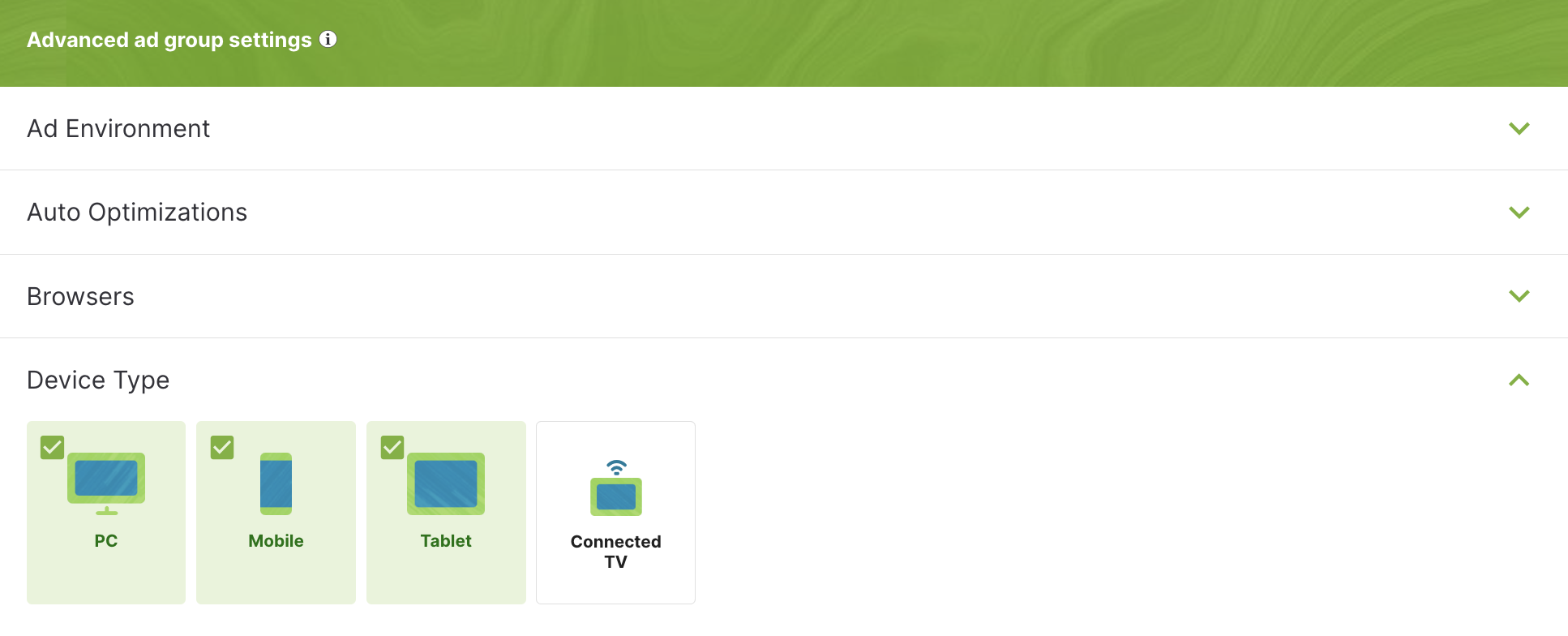
In Choozle Campaign Manager you can target at a broad device-type level: Desktop/Laptop, Mobile, Tablet, and Connected TV.
For more specific targeting (by OS, brand, model, etc.), you’ll use third-party data segments (custom audiences) within the data catalog.
Device Targeting
From the campaign’s “Action” menu click Edit, then select the ad group you’re working with, and under Advanced Settings expand Device Type. All device types are selected by default; deselect any you don’t want to target. At least one must remain selected.
Why use this:
-
If your message or creative is optimized for mobile (e.g., vertical video, thumb-friendly), you may choose to exclude desktop.
-
If you’re running a Connected TV (CTV) campaign, you might exclude mobile/tablet to focus budget on big-screen environments.
-
Controlling device types helps avoid mismatches (e.g., a mobile-specific offer being served on desktop where experience may differ).
Operating System Targeting
Choozle supports OS-based targeting through third-party data segments (searchable by terms like “iOS”, “Windows”, etc.).
Why OS matters:
-
OS can hint at audience demographics or behavior (e.g., iOS users might have higher spend or engage differently).
-
Some creative formats or experiences may perform differently on Android vs iOS vs desktop.
-
Device OS selection can help refine audience quality, e.g., excluding older OS versions with poor compatibility or focusing on latest OS where performance is better.
How to do it: -
In the data catalog find segments labelled by OS or device brand.
-
Layer these segments into your targeting at the ad group level.
-
Monitor performance by OS/brand and shift budget toward top-performing segments.
Common Pitfalls & How to Avoid Them
-
Over-restricting device types too early: If you exclude many device types initially you may limit reach and inflate CPMs. Start broader, optimize in.
-
Ignoring OS data: Without OS segmentation, you miss an easy lever for performance differentiation, especially where budgets are tight.
-
Not monitoring device/OS performance: If you don’t break down by device type and OS, you won’t know which environment is dragging performance.
-
Creative mismatch with device context: A mobile-optimized creative on desktop may under-perform. Always align creative to device type.
Need Help?
If you have any additional questions please reach out via your Customer Support Portal!